How to make rustc 94% faster (in some cases)
For those who suspect the title is a scam, I'm going to destroy your question with this chart:
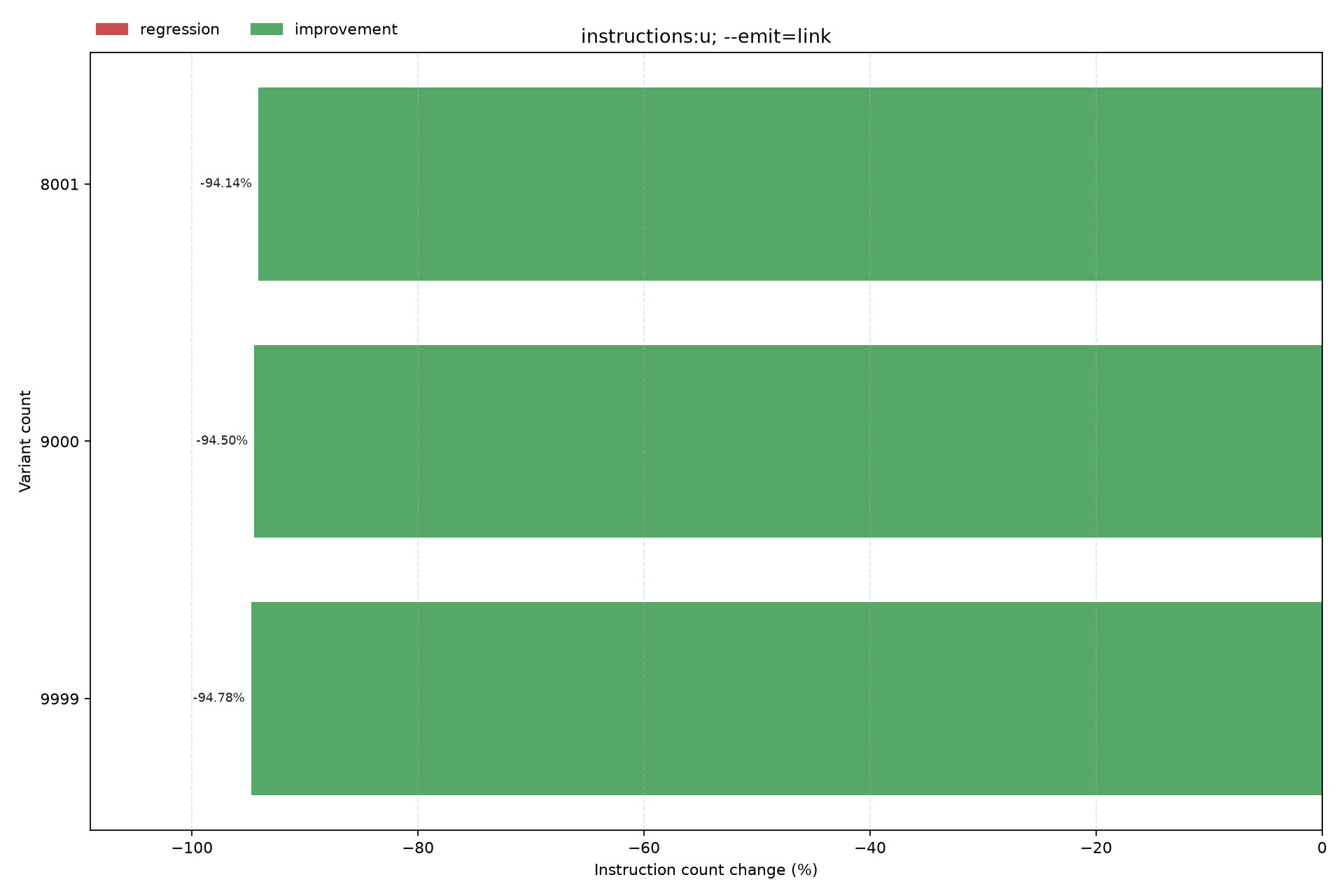
- You can find and reproduce the result here.
As you can see the test case is a file with 100 enums, each of which has over 8001 variants, which is apparently fairly common in the real-world rust code and you've probably written some code like this before, haven't you?
So... then?
So the story is about derive(Debug) expansion which is not that trivial.
The first implementation of derive(Debug) in rustc before Jan 21, 2023, 10:43 UTC was like this:
It looks... very straightforward! Here we have a match where each arm corresponds a function call. This is suboptimal since
every arm makes its own inline call to write_str(). That doesn't matter that much for small enums. For a large one,
though, all those calls add up to a bloated MIR body. Its MIR looks like this:
// simplified
bb2: {
    _10 = &mut (*_2);
    _12 = const "CC";
    _11 = &(*_12);
    _0 = Formatter::<'_>::write_str(move _10, move _11) -> bb8;
}

bb3: {
    _7 = &mut (*_2);
    _9 = const "BBB";
    _8 = &(*_9);
    _0 = Formatter::<'_>::write_str(move _7, move _8) -> bb8;
}

bb4: {
    _4 = &mut (*_2);
    _6 = const "A";
    _5 = &(*_6);
    _0 = Formatter::<'_>::write_str(move _4, move _5) -> bb8;
}

bb8: {
    return;
}
The obvious fix is to hoist the write_str out of the match. Each arm then only has to select a string, leaving a single call
to write_str in the generated function. This makes the MIR body much smaller. 1
This was done in rust-lang/rust#106884 by @clubby789 with a great perf win✌️.
Now the second version of derive(Debug) expansion looks like this:
Yes, looks so good so far, doesn't it? We often wish some stories could end at a point when we're content with how things are and pray that things won't go wrong or stray too far from our expectations. Nonetheless, usually, they head in a direction we'd never expect, yet somehow feel inevitable in hindsight.
The big one is coming
Consider the case where we have an enum with 132 variants. Now you can see the problem. Hoisting write_str doesn't really
patch the one-match-arm-per-variant hole, since the generated function still grows along with the enum:
- from the nix crate
Lookup table comes to the rescue!...?
There was already a lookup table solution to the problem, i.e. we create an array crammed with all the string literals and index into it with the discriminant. While the array still grows with the enum, of course, rustc doesn't need to generate one match arm per variant. This way we might have even better performance, but the caveat is that this requires the discriminants to be dense.
This attempt was implemented in both rust-lang/rust#109615 and rust-lang/rust#114190, while both showed a regression in the perf results.
I think directly looking at the generated MIR could help triage the problem. And I have to say, the moment I look at it, I found three problems 2:
- every
- godbolt
first impl of concatenated string: https://godbolt.org/z/8vhYxo9b7